
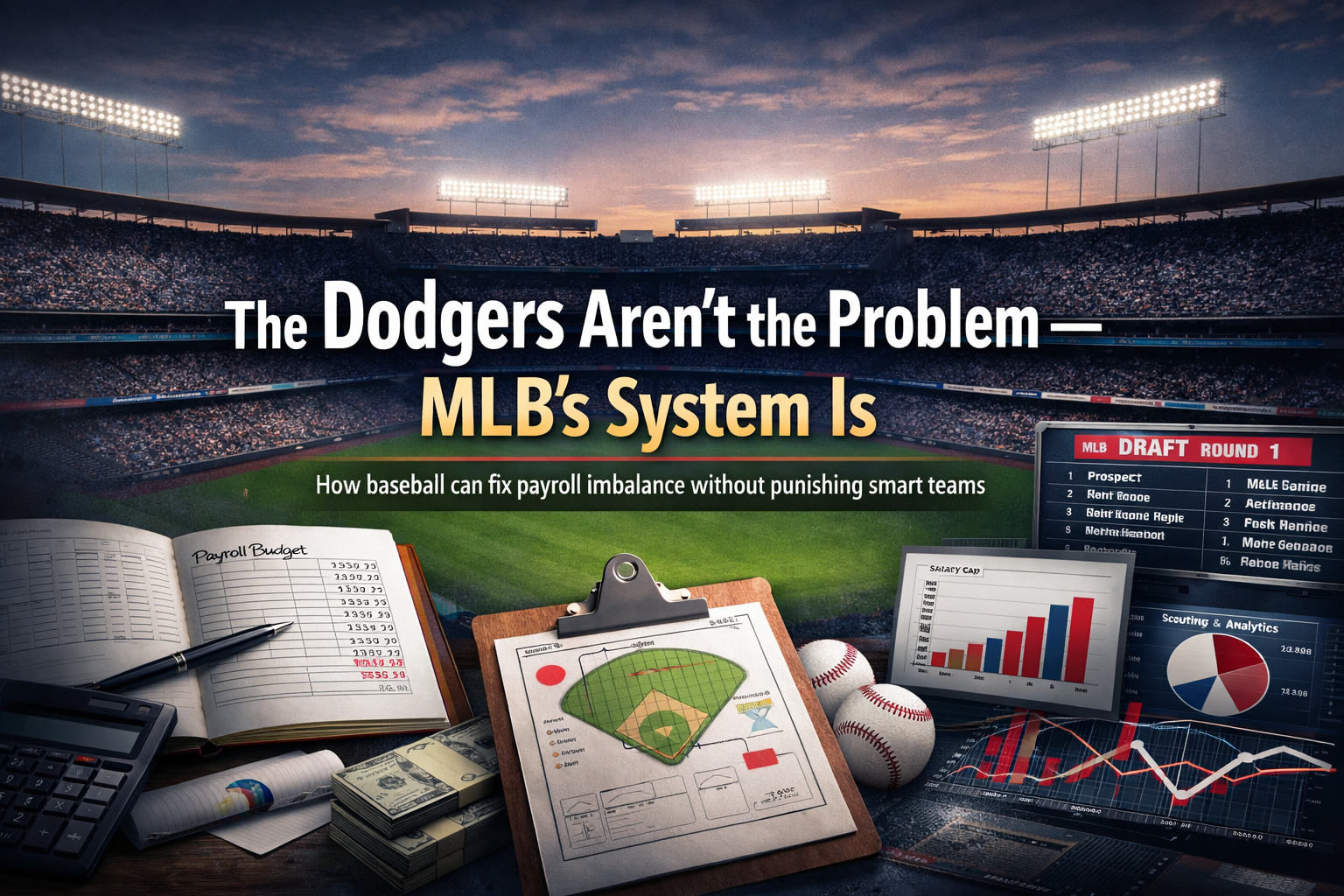
If you spend any time around baseball fans right now, you’ve heard it:
“The Dodgers are ruining baseball.”
But here’s the uncomfortable truth:
The Los Angeles Dodgers aren’t breaking the game — they’re exposing flaws that already existed.
The real issue isn’t spending.
It’s that Major League Baseball has created a system where massive spending comes with few real consequences, while some teams barely try at all.
And fans can feel it.
Why Fans Are Angry (and Why That Anger Is Misplaced)
Most fans aren’t anti-spending. They like the stars, big moves, and ambition.
What frustrates them is the perception that:
- Some teams can blow past payroll limits year after year.
- Pay a tax that barely slows them down.
- And keep stacking talent with no real roster impact.
That frustration isn’t about the Dodgers.
It’s about credibility.
The CBT Isn’t a Deterrent — It’s a Fee
MLB technically doesn’t have a salary cap. Instead, it uses the Competitive Balance Tax (CBT), intended to discourage runaway spending.
In reality, for elite revenue teams, the CBT has become:
- Predictable
- Budgeted
- Manageable
If a penalty can be planned for, it’s not a deterrent—it’s the cost of doing business.
That’s why fans don’t feel like the playing field is level, even when the rules are technically the same for everyone.
Step One: Stop Blaming the Dodgers
This part matters.
The Dodgers:
- Draft well
- Develop talent
- Trade intelligently
- And spend aggressively within MLB’s rules.
They didn’t invent the system. They optimize it better than anyone else.
If MLB wants to address fan anger, it cannot start by punishing teams for being smart. It has to fix the structure.
What MLB Could Do at the Next CBA
If Major League Baseball wanted to address fan concerns in the following collective bargaining agreement seriously, here’s what would actually work.
1. Make Overspending a Competitive Decision, Not a Financial One
Instead of only escalating taxes, repeat CBT offenders should face baseball consequences, such as:
- Draft position penalties
- Reduced international signing pools
- Restrictions on taking on a salary in trades
Teams could still spend — but not everywhere, all the time.
That forces real choices.
2. Fix the Deferred Money Optics
A major source of fan frustration isn’t payroll size — it’s payroll structure.
MLB could:
- Require deferred salaries to count at the proper present value.
- Limit the amount of money that can be deferred for payroll purposes.
- Require escrow funding for long-term deferrals.
This wouldn’t stop creativity.
It would simply make payroll math feel honest.
3. Enforce a Real Salary Floor
This part often gets ignored, but it’s just as important.
You can’t complain about big spenders while:
- Some teams pocket revenue sharing
- Run minimal payrolls
- And show no urgency to compete.
A mandatory salary floor would:
- Force every team to try.
- Shift blame from big spenders to non-competitive owners.
- Reframe the competitive balance debate entirely.
What Would Happen to the Dodgers?
If reforms were made, how would the Dodgers, as a case study, be affected?
Here’s the part fans often get wrong.
If MLB implemented these changes:
- The Dodgers would still be elite.
- They would still spend
- They would still attract stars.
What would change is that the Dodgers would need to make more deliberate choices about roster construction and future investments, with concrete limits on where and how they can allocate resources.
They’d have to decide:
- Do we add another veteran?
- Or protect future draft and international capital?
- Do we absorb this contract now?
- Or save flexibility for later?
Innovative organizations thrive under structure.
The Dodgers would adapt faster than most.
What Wouldn’t Happen
Let’s be clear about what this would not do:
❌ It wouldn’t turn the Dodgers into a small-market team
❌ It wouldn’t cause stars to flee big markets
❌ It wouldn’t create artificial parity
❌ It wouldn’t punish ambition
Great teams would still win, but they would now operate under concrete limits, creating more visible accountability and strategic trade-offs.
The Real Goal: Credibility, Not Parity
This isn’t about stopping excellence. It’s about restoring faith.
Fans don’t need every team to be equal.
They want to believe that:
- Everyone plays under meaningful constraints.
- Success comes from smart decisions, not unlimited leverage.
- And the system rewards competition, not complacency.
Changes like these would mainly challenge teams that overspend without results. Well-run organizations, such as the Dodgers, would still have advantages but would be compelled to act more selectively, benefiting competitive balance without penalizing ambition.
And that’s precisely how it should be.
Final Thought
The Dodgers aren’t ruining baseball. They’re showing us where baseball hasn’t kept up with itself.
Baseball thrives when its rules reward boldness, excellence, and competition. By addressing the system’s flaws instead of blaming those who navigate it best, MLB can create a fairer, more credible future for all teams—and remind fans why they love the game.


Leave a Reply