
If you’ve followed college baseball long enough, you’ve probably heard it:
“Check the RPI.”
For years, the Ratings Percentage Index (RPI) has been one of the primary tools used to evaluate teams for postseason selection. It’s supposed to measure team strength. It’s supposed to reward winning.
But in reality?
It often does the opposite.
The RPI system has become one of the most frustrating parts of college baseball — especially at the end of the season, when every game matters most. Instead of rewarding teams for winning, it can actually penalize them… even when they do everything right.
Let’s break down why the RPI system is outdated — and why it may be time for college baseball to move on.
What Is the RPI System?
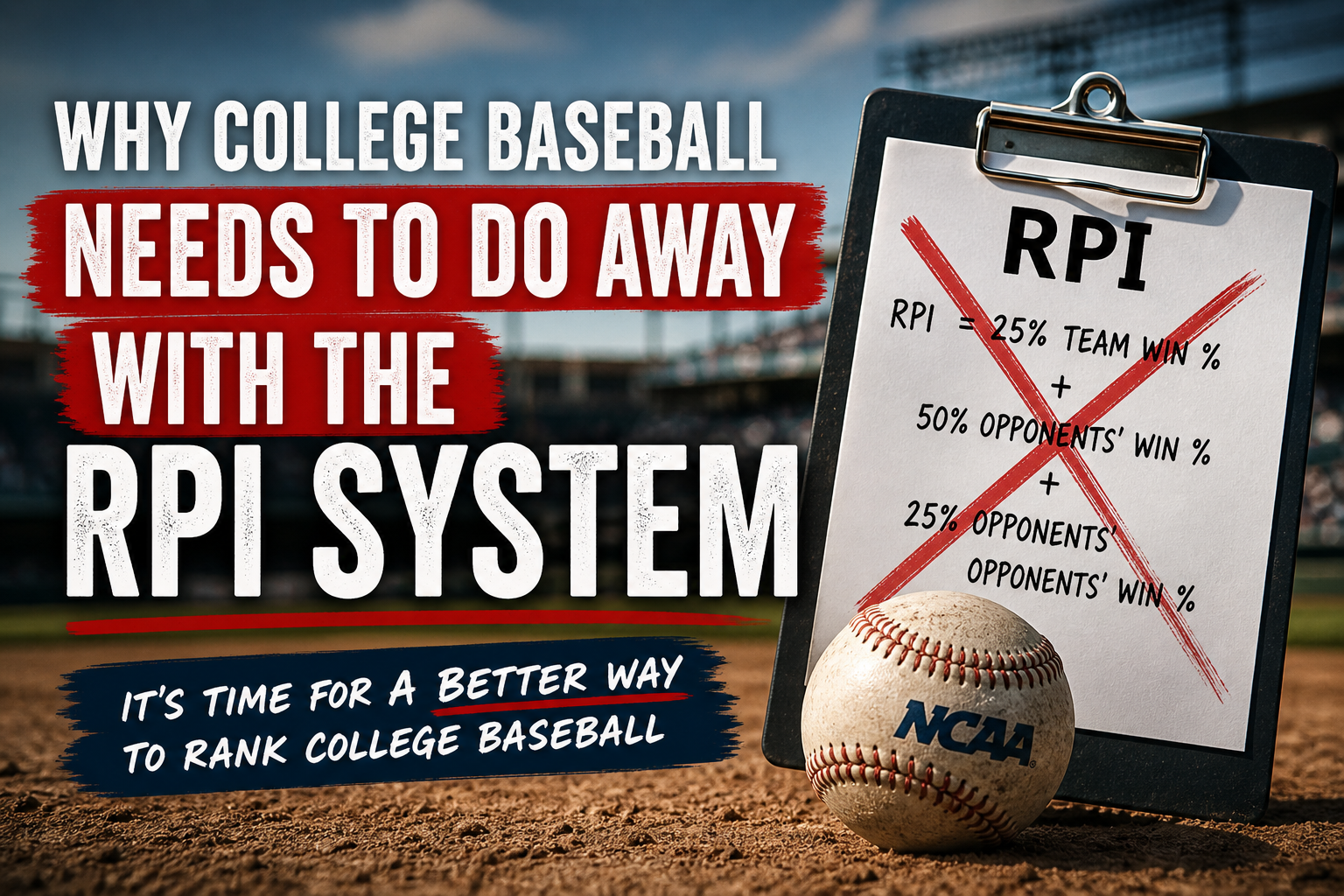
At its core, the RPI is built on a simple formula:
- 25% Team Winning Percentage
- 50% Opponents’ Winning Percentage
- 25% Opponents’ Opponents’ Winning Percentage
On paper, it sounds reasonable. It tries to account for the strength of schedule and overall performance.
But here’s the problem:
It relies heavily on factors teams cannot control.
The Biggest Problem: You Can Win… and Still Lose Ground
This is where things start to break down.
At the end of the season, teams are fighting for:
- Conference standings
- Regional hosting spots
- NCAA Tournament bids
You would think winning games would always help.
But with RPI?
That’s not always the case.
Example Scenario
A team wins a weekend series against a lower-ranked opponent.
Sounds good, right?
Not necessarily.
If that opponent has a poor overall record, the winning team’s RPI can:
- Stay flat
- Or even drop
Yes — a team can win a series and still hurt its postseason resume.
That doesn’t make sense in any sport.
Even Worse: Losing Can Sometimes Help
This is where the system really loses credibility.
Because RPI weighs opponent strength so heavily, teams that play stronger competition can:
- Lose games
- And still maintain or even improve their RPI
Meanwhile, teams that:
- Win games
- But against weaker opponents
Can fall behind.
That creates a system where losing the “right way” can be better than winning the “wrong way.”
That’s not competition — that’s math overriding performance.
The End-of-Season Problem
The flaws in RPI become most obvious in the final weeks of the season.
Teams are:
- Locked into conference schedules
- Facing opponents, they didn’t choose
- Trying to secure postseason spots
But instead of focusing on winning, teams and fans are watching:
- Other teams’ records
- Opponents’ opponents
- Scoreboard math
At that point, the conversation shifts from:
“Did they win?”
To:
“Did their RPI move?”
And that’s where the system starts to feel broken.
It Punishes Teams for Things They Can’t Control
Let’s be real — teams can control:
- Effort
- Execution
- Winning games
They cannot control:
- How good their opponents end up being
- How those opponents perform against others
- Conference depth year-to-year
Yet the RPI heavily depends on all of those.
That’s a major disconnect.
Mid-Major Programs Feel It the Most
If you want to see the biggest impact of the RPI system, look at mid-major programs.
These teams:
- Often dominate their conferences
- Win a high percentage of games
- Still struggle to get respect in rankings
Why?
Because their opponents may not have strong records.
So even when they win consistently, their RPI doesn’t reflect it the same way it would for a Power 5 program.
That creates a built-in disadvantage.
College Baseball Has Outgrown RPI
The biggest issue isn’t just that RPI has flaws.
It’s that the sport has evolved past it.
Today, we have access to:
- Advanced analytics
- Strength-of-schedule metrics
- Predictive rankings
- Performance-based data
Other sports — including college basketball — have already moved toward more modern systems.
College baseball?
Still leaning heavily on RPI.
At some point, the system needs to catch up with the game.
What Could Replace It?
No system will be perfect — but there are better options.
A more modern approach could include:
Weighted Wins and Losses
Give more value to quality wins, not just opponent records.
Performance Metrics
Run differential, pitching performance, consistency.
Context-Based Evaluation
Late-season performance, road wins, conference strength.
Selection Committee Balance
Use analytics as a tool — not the deciding factor.
Final Thoughts
The goal of any ranking system should be simple:
Reward teams that win.
Right now, the RPI system doesn’t always do that.
Instead, it creates confusion, frustration, and outcomes that don’t always reflect what happens on the field.
College baseball deserves better.
Because at the end of the day:
Winning should always matter more than the math.




Leave a Reply