
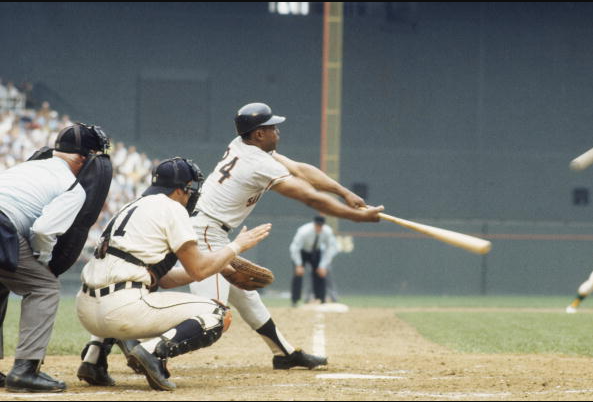
Willie Mays, often hailed as one of the greatest baseball players of all time, had a career spanned over two decades, leaving an indelible mark on the sport. Born on May 6, 1931, in Westfield, Alabama, Mays grew up in a family deeply rooted in baseball. His father, William Howard Mays Sr., was a talented baseball player in the Negro Leagues, and his mother, Annie Satterwhite, was a star high school sprinter. This athletic pedigree set the stage for Willie Mays’ illustrious career.
Mays’ early exposure to baseball came from playing with his father and watching Negro League games. By age 16, he was already playing professionally with the Chattanooga Choo-Choos, a semi-professional team. His talent quickly caught the attention of the Birmingham Black Barons, and he joined their ranks in 1948, contributing to their success and further honing his skills.
In 1950, at 19, Mays was signed by the New York Giants. He started in their minor league system, playing for the Minneapolis Millers. His exceptional performance there—batting .477 in just 35 games—earned him a call-up to the majors in 1951. Mays’ impact was immediate despite a slow start. His first hit was a home run off the legendary Warren Spahn. By the end of his rookie season, he had won the National League Rookie of the Year Award, helping the Giants to a pennant and a memorable World Series against the New York Yankees.
Mays’ career was temporarily interrupted by military service in 1952-1953, but he returned in 1954 without missing a beat. That year, he led the Giants to a World Series victory over the Cleveland Indians and won the National League MVP Award. One of the most iconic moments of his career came during that series, with “The Catch”—a breathtaking over-the-shoulder grab in deep center field that remains one of the baseball’s famous defensive plays in baseball history.
Over the next two decades, Mays’ career was defined by consistency, excellence, and a rare combination of speed, power, and defensive prowess. He was a 24-time All-Star, hitting 660 home runs, ranking fifth on the all-time list. His 12 Gold Glove Awards underscore his defensive genius, often patrolling center field with an almost supernatural ability to track down fly balls.
Mays’ talents extended beyond his athleticism; his exceptional baseball IQ allowed him to excel in every aspect of the game. He stole 339 bases in his career, demonstrating a keen sense of timing and an ability to read pitchers. Mays was known for his enthusiastic and joyful approach to the game, earning him the nickname “The Say Hey Kid.”
In 1958, the Giants moved to San Francisco, and Mays continued to be the team’s cornerstone. Despite the challenges of transitioning to a new city and stadium, he adapted quickly and continued to deliver stellar performances. His dedication and charisma helped establish a solid base for the Giants in their new home.
Beyond his on-field achievements, Mays faced and overcame significant racial barriers. Playing during an era when baseball was still grappling with integration, he handled the pressures of being an African American superstar with grace and dignity. His success helped pave the way for future generations of black athletes in baseball and other sports.
Willie Mays retired in 1973 after a brief stint with the New York Mets. His final years as a player were marked by his transition into a revered elder statesman of the game. In 1979, he was inducted into the Baseball Hall of Fame on his first ballot, cementing his legacy as one of the all-time greats.
Mays has continued contributing to baseball as an ambassador and mentor in retirement. His influence is seen in the generations of players who followed him, many of whom regard him as the epitome of what a baseball player should be. His life and career remain a testament to the power of talent, determination, and passion for the game. Willie Mays’ story is not just one of individual greatness but of a transformative figure who left an indelible mark on baseball.
Main Image Credit – WASHINGTON – 1969: Willie Mays of the San Francisco Giants completes his swing and connects with the ball during the All Star Game at Robert F. Kennedy Stadium in Washington, D.C. in 1969. (Photo by Focus on Sport via Getty Images)


Leave a Reply